
Exhibition
BaseCamp
For a second year we curated the arts programming at the Locarno Film Festival in Switzerland. The project spanned four rooms and a garden a nomadic publishing house rewriting its own rules through daily exchange, oaks and glass and video installations sounding out the politics of borders and prediction, benches that turn listening into a political act, and a rotating video programme that stages daily encounters between eight distinct voices on planetary knowledge, memory, the gaze, and collective dreaming. Each project enters the space with its own register, yet each answers, in some way, the same question posed by the curatorial premise: what does it mean to sing together, in dissonance as much as in harmony. The works that follow are your invitation to listen.
Room 1: Martino Santori, Dummy Records & Books
Dummy Records & Books, a project by Martino Santori, is a nomadic publishing house that made its debut at the Castello Visconteo in Locarno. The project, which combines installation and performance art, is characterized by a temporary and ever-changing structure and a DIY, collective approach. Dummy Records & Books takes root in the spaces of the Casorella Museum with just a few initial elements: a publisher, a graphic framework, a few printing presses, a CD burner, and a "weird library." With these, Dummy Records & Books opens its doors for the duration of Basecamp, shaping its editorial line through exchange and interaction with festival participants. Through an improvisational process of playfully reimagining a canonized and regulated space, Dummy Records & Books takes shape via a method of procedural knowledge and collective gardening that establishes its own rules and manifesto of existence through action and the design of languages and editorial products open to continuous modification, action, and spontaneous growth. The final act of this first appearance by Dummy Records & Books will feature a presentation of the editorial and audio works created during the experience; and like a geophyte, the space will have the potential for reactivation and renewal in the months to come.
Room 2: Ishita Chakraborty, Protest Song: Winds of Change (2025) Ishita Chakraborty places a megaphone inside a native oak tree from the forest of Locarno. The megaphone broadcasts a song recorded by exiled Iranian musician Hura Mirshekari, sung in Sistani, a rarely spoken Persian dialect, and joined by Bulgarian singers Viktor Benev and Bilyana Furnadzhieva. The tree becomes a meeting point between native and foreign voices, but the installation reflects on the intertwined histories of human and plant migration across borders.
Room 3: Ishita Chakraborty, Between the Land and Sea (2025) & Dimitri Gorbaty, CONQUERED (2026), two-channel video 5 minutes loop. Between the Land and Sea renders a steel crowd-control barrier in mouth-blown glass. Glass requires intense heat to shape, echoing the heated politics of borders and nationalism. The work appears inviting at a distance, but up close, its fragility turns hostile. By swapping steel for glass, Chakraborty questions how permanent these systems of control really are. Shown alongside it, Dimitri Gorbaty's two-channel video CONQUERED loops documentary footage of people in public space through an AI model that repeatedly predicts their next positions. The piece asks what happens when human behavior becomes something to categorize and anticipate: prediction as a tool of governance, not just observation. Each figure in the footage carries a voice; together they form a choir. As the two channels drift out of sync, the spatial audio shifts with them. The lyrics draw on the hymn "I Surrender All," a meditation on surrender in the face of hardship.
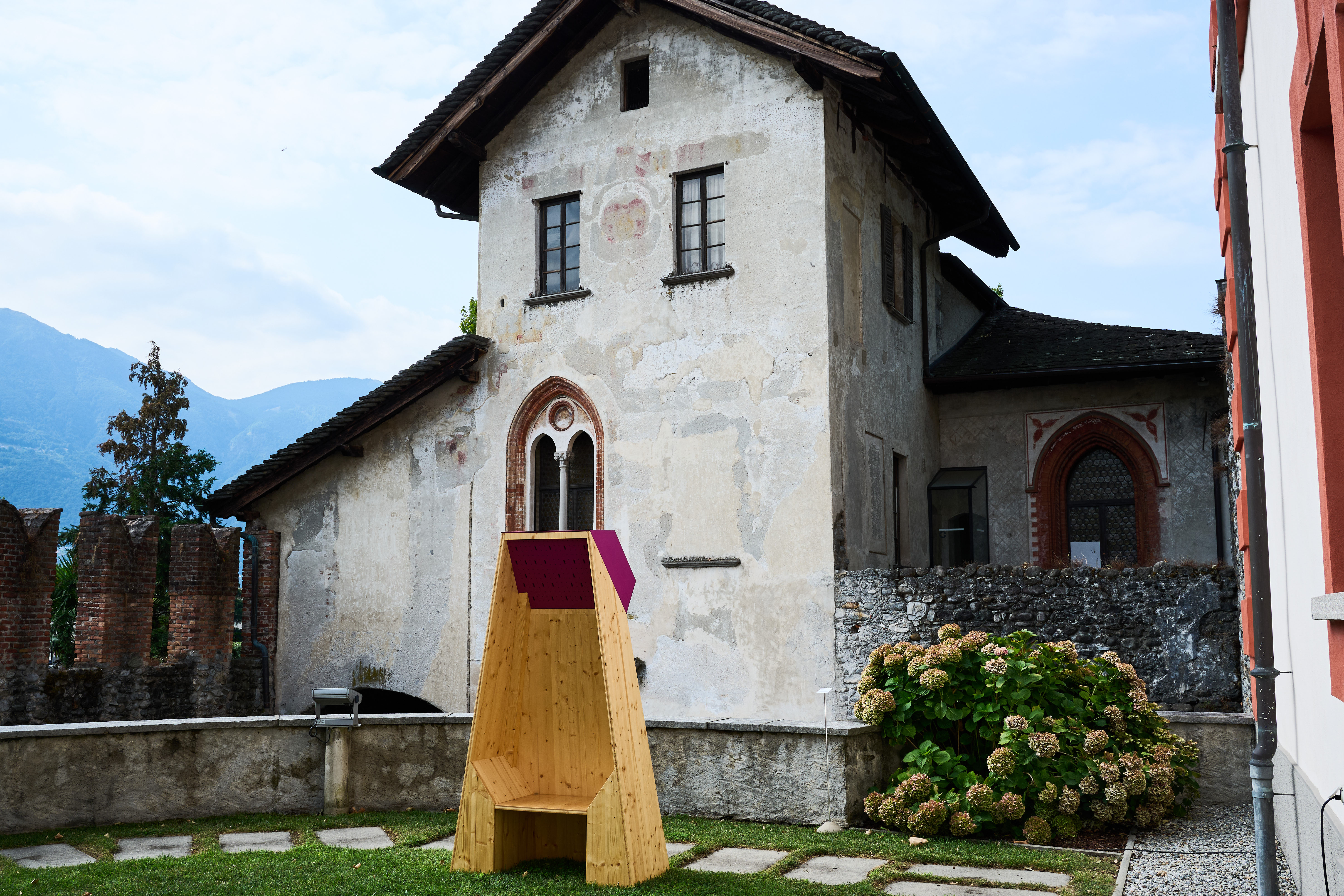
Garden: Ishita Chakraborty, Whispering Benches, (2021–2022) In this garden installation, two sound-embedded benches invite visitors to sit and listen. Made with inmates from the carpentry workshop at JVA Cazis Tignez in Graubünden, the benches play stories, poetry, and songs about migration, displacement, and colonial legacy. Sitting becomes an act of listening, and listening becomes political.
Room 4: Vis-à-Vis / Twice Told, Rotating video programme, An Installation for the Future (of) Together Conference. Curated by Silvia Cipelletti, Marine de Dardel, Flavia Mazzarino.
Vis-à-Vis / Twice Told is a daily changing series of audiovisual works by Äsel Kadyrkhanova, Shaina Anand (CAMP), Ursula Biemann, Nitin Bathla & Klearjos E. Papanicolaou, Ute Holl & Peter Ott, Rosa Menkman, Hira Nabi and Felix Sobolev. The works are set in dialogue with one another, inviting deeper reflection on the theme of togetherness and questioning what it means to watch, narrate, and think collectively. Topical threads—an essay, a road, microcosms, plants, cable television, algorithms—interweave across different times, geographies, milieus, media and resolutions. Each piece both carries its own singularity and an imprint of the others it meets. Every day, the installation sets two resonant works face to face, giving togetherness and chorality a performative dimension: motifs are told twice, across two screens, a multivocal chorus assembled within a spatial encounter.
Outside: Castello Visconteo
Alongside the exhibition, BaseCamp commissioned four new site-specific installations for the Castello Visconteo, developed in dialogue with this year's BaseCamp theme, A Promise to Respect. The brief was to work with the Castle's existing material and history rather than install over it. Two of the four were made in collaboration with Refusés.
Sarah Baumgartner's Unravelling, Becoming (2026) is built through arm-knitting, a technique that binds the body directly to the material, using unspun wool cut, ripped, reworked, and dyed with natural pigment. The dyes come from food waste sourced from local Locarno businesses, onion skins, spinach, chamomile, and red cabbage. Each sculpture marks a different stage between construction and deconstruction and is arranged to adapt to the space it sits in.
Martina Casey's ceramic sculpture, new moon in Cancer had me tweaking / a salamander became my friend (2026), places a salamander, a figure long tied to transformation in mythology and alchemy, as a companion during a new moon in Cancer, an astrological transit associated with introspection. Casey works across wood, papier-mâché, concrete, mosaic, and ceramic, letting each material's properties shape the final form. Casey (b. 1996) is a Swiss artist based in Basel who begins a residency at the Cité internationale des arts, Paris, in April 2027.
Weronika Wolińska's Common Area turns the Castle courtyard into an inflatable structure, its geometric shell drawing on Brutalist architecture and the repetitive facades of grey apartment blocks. Built to be entered and used rather than viewed from outside, it functions as a temporary public gathering space, closer to a playground than a sculpture.
Guerrilla Spam's intervention works directly with the traces already present in the Castle's walls, responding to the layers a place accumulates over time rather than adding a separate object to the site.
In the garden, the durational performance 1m² examined how the body registers space and time under constraint. Resident artist Hongxi Li and collaborating artist Lulu Wang built an elevated platform from modular one-metre raised floor panels, the same unit used to grid and measure space in cities, and treated space and time as two connected mechanisms of control, one compressed into restrictive grids, the other standardised into the fixed structure of the 24-hour day. Over a ten-day residency, Li and Wang entered the platform in cycles of thirty to sixty minutes alongside festival audiences and local dancers, generating a new set of "Rules of Occupancy" each day rather than working from a fixed script.
Date
5 – 15 August 2026
Location
Locarno, Switzerland
Artists
- Martino Santori
- Ishita Chakraborty
- Dimitri Gorbaty
- Sarah Baumgartner
- Martina Casey
- Weronika Wolińska
- Guerrilla Spam
- Hongxi Li
- Lulu Wang
Interested in works from this exhibition?